

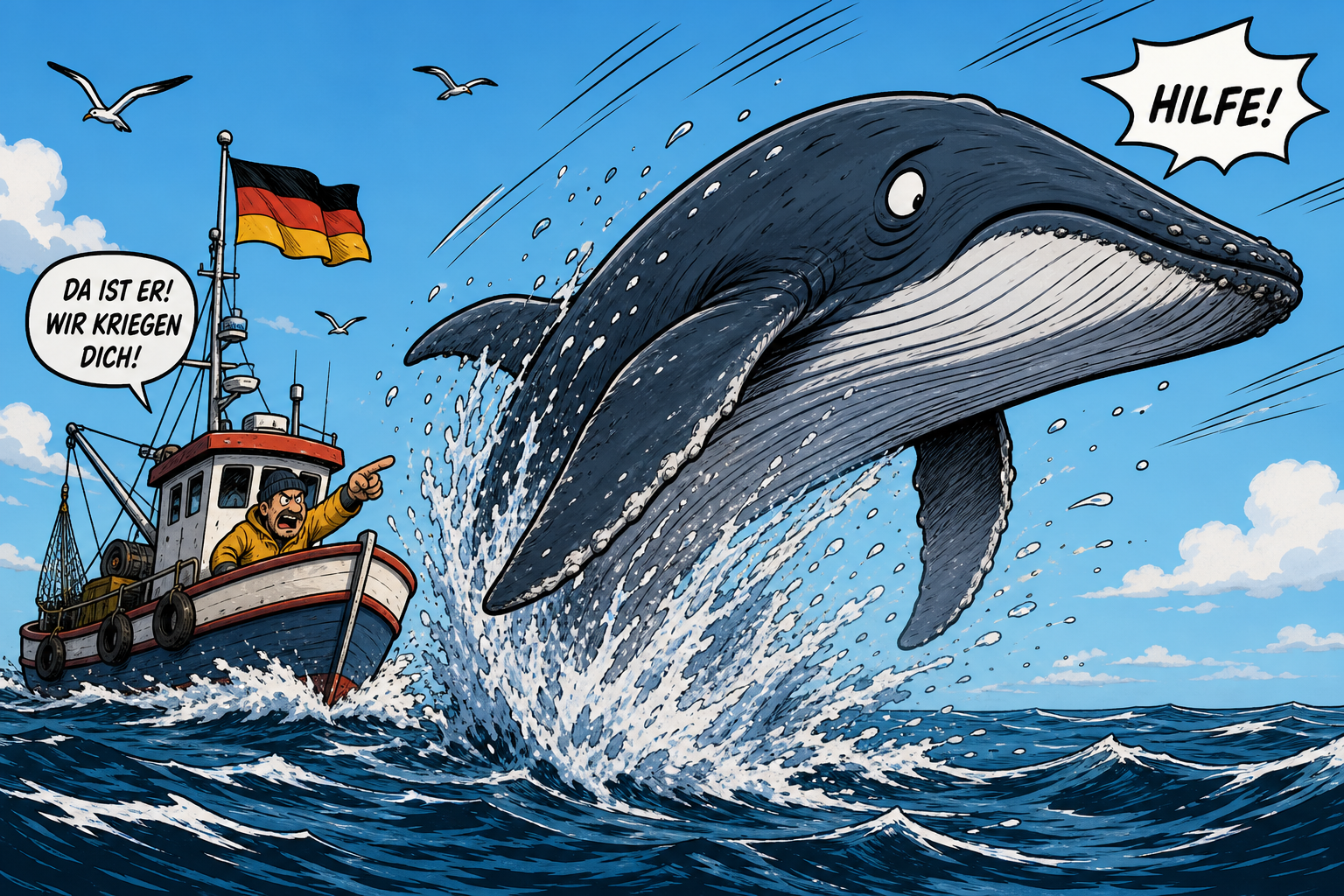
The Timmy Case as a Lesson in How German Politics Uses — and Misuses — Science
On 14 May 2026, the carcass of a humpback whale was discovered off the Danish island of Anholt. Two days later, the authorities confirmed it: Timmy. For six weeks, an already weakened, stranded animal had captivated the German public — and in the end, exactly what scientists at home and abroad had predicted from the outset came to pass. The animal had not survived its transport to the North Sea.
This is not a eulogy for a whale. It is a piece about how a political culture treats its own advisors.
The Chronicle of a Conscious Reversal
The factual record is essentially uncontested. In early April, experts — among them Burkard Baschek, scientific director of the German Oceanographic Museum in Stralsund — together with the environment ministry of Mecklenburg-Vorpommern concluded that the animal was too weak. The diagnosis: freshwater skin disease, remnants of rope and netting reaching into the digestive tract, irregular breathing, near-immobility. The expert recommendation was to let the whale die in peace. The state government accepted this recommendation — at first.
Then, in the words of marine biologist Fabian Ritter, quoted in the US journal Science, the ministry executed „a 180-degree turnaround.“ Scientific assessment no longer set the agenda; public outcry did. A privately funded consortium was permitted to load the whale onto a barge and tow it to Skagen.
The international scientific reaction was unusually direct. The International Whaling Commission (IWC), the global body for cetacean research and conservation, called the rescue effort „inadvisable“ in its statement of 28 April. Active interventions such as refloating or barge transport, the IWC’s strandings expert panel said, should as a rule be rejected on grounds of animal welfare and human safety. The International Fund for Animal Welfare (IFAW) added that interventions must follow clear scientific criteria — condition, location, likelihood of survival — and that further interventions on severely compromised animals only increase suffering. Matthew Savoca, a marine biologist at the California Marine Sanctuary Foundation, told Scientific American in plain terms that the whale would probably not survive the transport.
That is exactly what happened.
The Function of Science in the Political Apparatus
What is striking about this case is not the emotional response of a public watching a suffering mammal. What is striking is the mechanics behind it. Science was drawn into the process twice — once to legitimise the decision to „let it die,“ and once to explain why one was now intervening after all. In neither instance was science actually consulted; it was cited. It was stage scenery, not advisor.
This mechanic is not confined to whales. It is a recurring pattern in German politics. In debates over wolf populations, studies on population numbers are produced or buried depending on the lobby constellation. In energy policy, expert opinions tend to confirm decisions the governing coalition has already made. During the pandemic, it became visible how selectively scientific voices were elevated when they fitted the political line — and how politely others were ignored. Glyphosate, the combustion-engine phase-out, cannabis reform, agricultural biotechnology: the same pattern recurs. Science as rhetorical reserve, not as corrective.
This is not reprehensible in every individual case. Politics is allowed to weigh scientific recommendations against other values — and is not obliged to follow them blindly. But it ought to be honest when it doesn’t. German practice is otherwise. It dresses political decisions in the cloak of scientific necessity — and takes that cloak off the moment the science becomes inconvenient.
Who Is Actually Speaking When „the Public“ Speaks?
In the Timmy case, it was repeatedly claimed that „the people“ wanted the whale rescued. The actually active participants were around fifty demonstrators in the harbour of Kirchdorf on the island of Poel, a few very loud voices on social media — including, as the environment ministry itself warned, manipulated content and fraudulent fundraising appeals — a handful of NGOs, and two private donors. That is not a representative majority.
This is where a structural problem of German public debate sits: organised volume is steadily replacing the silent breadth. Anyone who is not in a party, not in an NGO, not in an association has effectively no weight in the decision-making chains — even when they constitute the numerical majority. Political sensitivity to media moods is being confused with democratic legitimacy.
The result is a democracy that becomes more reactive, more short-winded, and that treats its own advisory bodies — councils of experts, ethics commissions, scientific advisory boards — as scenery to be rearranged according to the play being staged.
The Historical Subsoil
Here caution is in order, but so is honesty. Germany has experienced in its recent history what follows when scientific rationality yields to politically-emotional mobilisation. No one should draw a direct line from a questionable whale decision to past injustices — that would be intellectually dishonest. But it is also not the case that Germany’s post-war order, with its expert councils, ethics commissions, and scientific advisory boards, came about by accident. It was a deliberate response to a historical experience. That response was: political decisions are to justify themselves before the forum of reason, not the forum of outrage.
If the scenery mentality entrenches itself — if scientific advice exists only as a confirmation ritual — that promise erodes quietly. Today it is a whale. In the next crisis, in the next mobilisation wave, it will be something else. The mechanics remain.
What Should Change
Three sober demands follow from this.
First: anyone who commissions scientific advice and then decides against it should have to say so openly — and explain why. A 180-degree reversal without public justification damages the credibility of every further consultation.
Second: international expert voices belong in the German debate. It is conspicuous how rarely the statements of the IWC, of IFAW, or of researchers like Savoca appeared in German coverage — and how rarely politicians had to position themselves in relation to them.
Third: politics should stop confusing media escalation dynamics with democratic mandate. A livestream is not an election. An online petition is not a plebiscite. A hashtag is not a majority.
Objections
Fair objections can be raised against this reading, and they belong in the text. First: in individual cases, emotional intensity may point to aspects that a narrowly defined natural science overlooks. Animal welfare is not only a biological but also an ethical category. Second: politics is the weighing of values, not pure data management — and value-weighing is democratically legitimate even when it contradicts expert recommendations. Third: even internationally, the assessment was not entirely uniform; individual voices considered the transport defensible provided the animal was stable.
These objections deserve serious treatment. But they do not change the core: a government that within weeks overturns its own scientific recommendation because the media wind has shifted is not treating science as a source of knowledge. It is treating it as a tool.
- Wie gefährlich ist Friedrich Merz?

- 733.863 Menschen haben eine Werbung gesehen. Ich auch, und ich habe es genossen.

- Doc Bobs Loblied: Wie ein wehrhafter Kanzler einer Kinderärztin 500 Milliarden Gründe gab

- Paganella Part 1: The New TOP GUN Trail & Why I Skipped Lake Garda | #MTBlife S04E13

- MTBlife S04E09 | 3-Länder Enduro Trails Nauders – Ein Tag, drei Länder, ehrliche Trails

- The Derailleur Is Dying. The Wattage War Isn’t. Avinox MG vs. Gobao – Inside the Gearbox Fight

- Zugspitzpark Ehrwald – The Complete Guide for Your Visit

- HISTORISCHER DURCHBRUCH: Brüssel beendet 30 Jahre Marmeladen-Terror – Millionen Frühstückstische aufatmen

- Tiroler Zugspitz Arena MTB: Geheimtipp am Fuß der Zugspitze – Biberwier & Lermoos | #MTBlife

- Warum Deutschland endlich aufhören sollte, sich für seine Flagge zu entschuldigen

- Größter Indoor-Bikepark der Welt – die unglaubliche Geschichte von Ray Petro

- Atemberaubende FPV-Drohnenaufnahme zeigt Red Bull Hardline aus völlig neuer Perspektive

No responses yet