

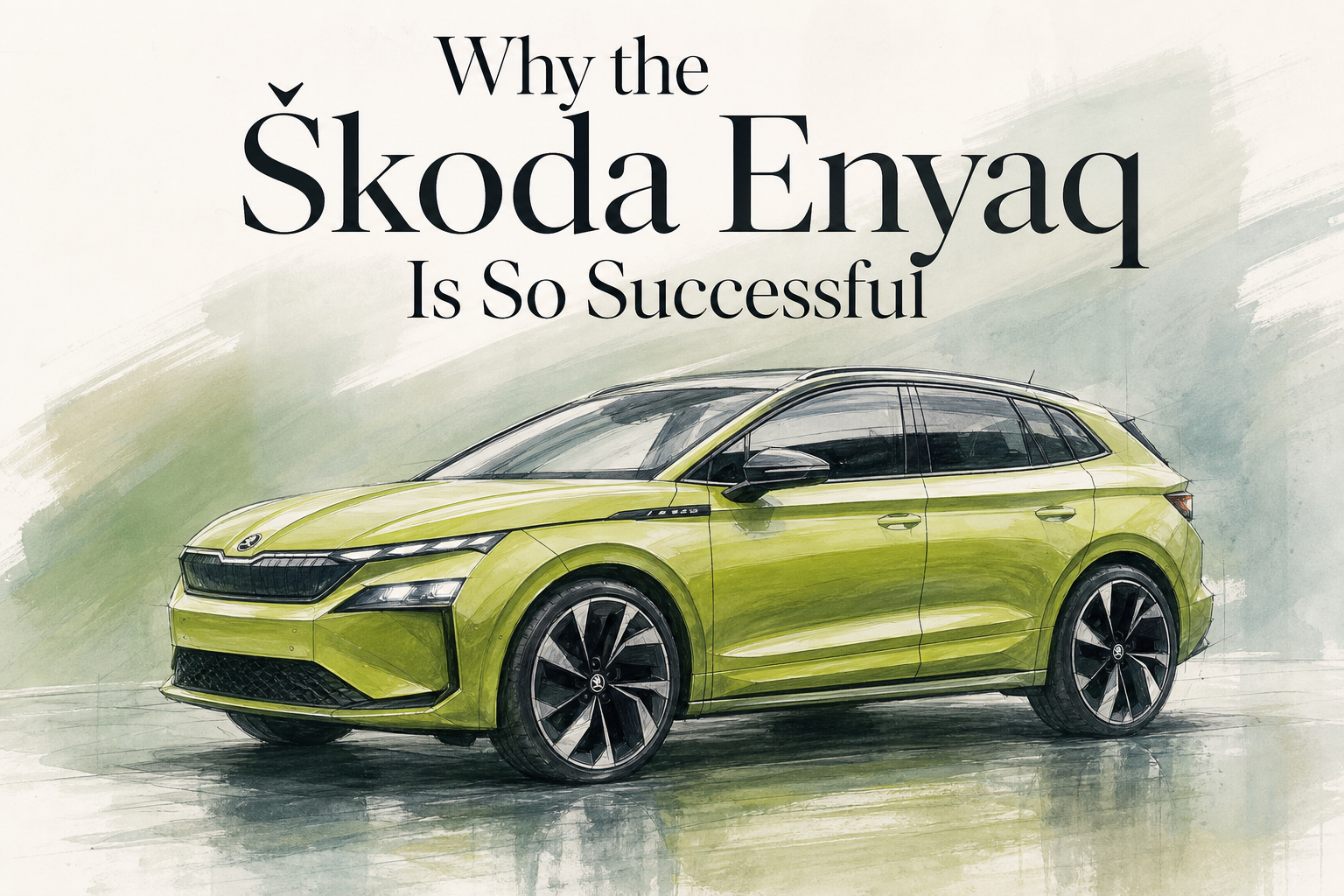
How the Czech electric SUV is holding its ground in Europe’s most competitive segment — and which rivals could actually threaten its position.
Drive through any European city in early 2026 and you’ll spot one at every other traffic light: the Škoda Enyaq. Sometimes an understated SUV in steel grey, sometimes a sporty coupé, occasionally a vivid green RS. Since production began in late 2020, more than 300,000 units have rolled out of the Czech plant in Mladá Boleslav. In 2025, the Enyaq ranked seventh among Europe’s best-selling electric cars — behind the Tesla Model Y, the surprisingly successful smaller sibling Elroq, and a handful of European rivals, but comfortably ahead of every other mid-size electric SUV in the volume segment.
That’s remarkable, because the Enyaq plays in the most contested arena of the EV market. Here it faces in-group rivals, Korean technology leaders, the Californian heavyweight, and a growing wave of Chinese newcomers. Yet the Enyaq has stayed near the top for years — and the reason isn’t a single stroke of genius. It’s the consistent sum of rational decisions.
The Price — but Not Just the Price
With a list price starting at just under €43,000 for the Enyaq 60, Škoda undercuts not only its premium sibling Audi Q4 e-tron significantly, but also the entry-level Tesla Model Y. Choose the larger 77 kWh battery in the Enyaq 85 and you get up to 586 km of WLTP range for around €47,000. In this segment, that combination of price and range is hard to beat — and it’s one of the main reasons the Enyaq is a top pick for fleet customers and leasing buyers.
The key point: Škoda hasn’t bought the low price by visibly cutting corners. Build quality is at group standard, the cabin feels tidy and high-grade, and the safety package earns top marks at Euro NCAP. The value proposition reads: no premium badge, but premium substance.
Space That You Can Actually Use
The second core argument is practicality. With 585 litres of boot space, the Enyaq doesn’t just clearly beat the closely related VW ID.4 — it also outscores the previous-generation BMW iX3 by some 75 litres. Fold the seats down and you get 1,710 litres. The 2.97-metre wheelbase — almost Superb territory — delivers rear-seat space that makes many mid-size saloons look cramped.
Add to that the traditional Škoda trump card: Simply Clever. An ice scraper in the fuel flap, an umbrella in the door, thoughtful storage everywhere — small details that make a big difference in daily life, and have earned the brand a loyal following for years. The 2027 model year adds a 21-litre frunk and V2L functionality — features long seen as MEB platform weaknesses.
The Platform Logic
The Enyaq sits on the Volkswagen Group’s MEB toolkit — the same platform as the ID.4/ID.5, Audi Q4 e-tron, Cupra Tavascan and Ford Explorer/Capri. For Škoda, that means massive economies of scale in development and component costs. For customers, it means mature technology backed by years of experience, a dense service network and reliable parts supply. The software problems that plagued the early VW ID.3 largely passed the Enyaq by.
The early-2025 facelift sharpened the package further: drag dropped to a Cd of 0.245 (0.225 for the Coupé), and ADAC Ecotest consumption on the all-wheel-drive 85x fell from 20.2 to 18.9 kWh per 100 km. It sounds unspectacular, but in practice it translates directly into running costs — and in this segment, that often decides the deal.
A Line-Up for Every Need
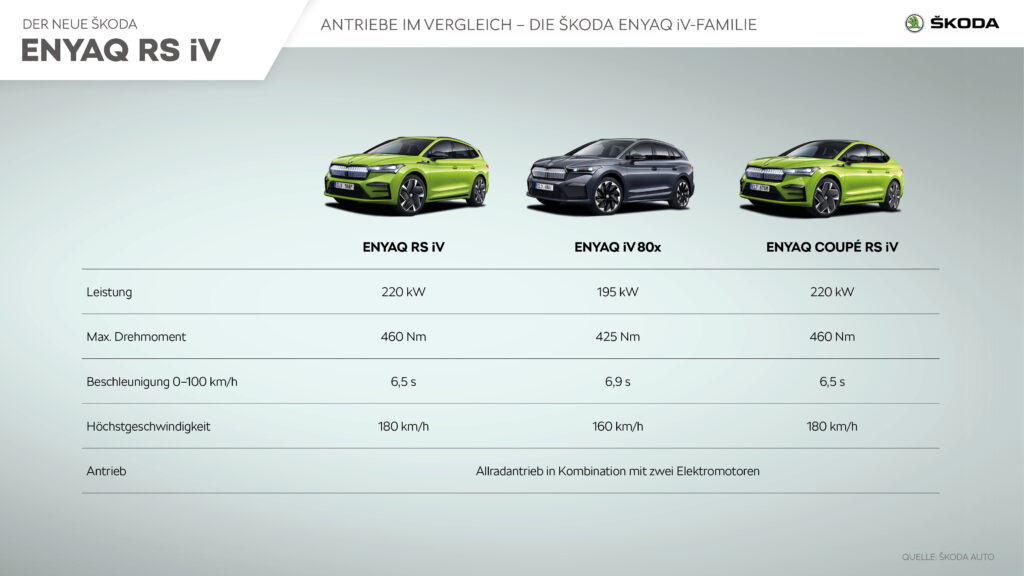
Four powertrain variants — 60, 85, 85x and RS — plus two body styles (SUV and Coupé) deliver a range of choice most rivals can’t match. The line-up spans from the 204 hp rear-driven commuter to the 340 hp RS all-wheel-drive for sporty buyers. Pick the Coupé with its more steeply raked rear screen and you even gain a few kilometres of range — at the cost of just 15 litres of boot space.
This flexibility puts the brand into serious competition with premium players: a well-specified Enyaq RS costs less than an Audi Q4 e-tron 55 quattro — and offers more room.
The Škoda Brand Has Grown Up
Perhaps the most important factor. For years now, Škoda hasn’t been seen as „the cheap VW alternative“ — it’s become the rationally smart choice. In Germany alone, Škoda delivered over 211,000 vehicles in 2025, making it the brand’s single biggest market. Globally, Škoda topped the one-million mark again and is now the third-best-selling automotive brand in Europe. In EVs, it ranks fourth among manufacturers — only Volkswagen, BMW and Tesla sell more electric cars in Europe.
This strength of the parent group reflects directly on the Enyaq: residual values, leasing terms, dealer density and brand trust are in a league that many younger EV brands (from Lucid to Polestar to the Chinese newcomers) simply can’t match.
The Competitors — and Why They Haven’t Dethroned the Enyaq Yet
The mid-size electric SUV segment is more crowded than any other. Three groups stand out:
The in-group siblings. The VW ID.4/ID.5 is mechanically identical but slightly tighter inside and not necessarily cheaper. The Audi Q4 e-tron targets premium buyers and quickly costs €10,000 more. The Ford Explorer and Cupra Tavascan share the platform but lose to the Enyaq on pure value for money. Within this family, Škoda is clearly the pragmatic sweet spot.
The Korean technology leaders. Hyundai Ioniq 5 and Kia EV6 set the benchmark for fast charging with their 800-volt architecture — a clear technical edge. Their design is bolder and appeals to a younger demographic. But they cost more, and the Enyaq beats them on usable space and value. The biggest threat in the Volkswagen Group universe is actually the Enyaq’s own little brother, the Elroq, which racked up over 95,000 deliveries in 2025, took second place among Europe’s bestsellers, and was named „German Car of the Year 2026“.
The Tesla Model Y benchmark. With more than 128,000 European registrations, the Model Y remains the number one — but Tesla’s market share fell noticeably in 2025. The Model Y beats the Enyaq on software, charging network (Superchargers) and efficiency. The Enyaq wins on space, build quality and a more conventional control layout with real buttons and well-thought-out ergonomics. If you want a car rather than a rolling tablet, you’ll lean toward the Enyaq.
Beyond these, there are other players: the Renault Scénic E-Tech (Car of the Year 2024, aggressive pricing), Volvo EX40 (premium ambition in a smaller package), Nissan Ariya (falling behind), the new BMW iX3 on the Neue Klasse platform (arguably the most exciting model from 2026 onwards), and the Chinese newcomers — led by the Zeekr 7X, which has rocketed into Europe’s top 10 thanks to Geely synergies. All of them put pressure on the Enyaq, but none has yet matched its combination of space, range, price and brand trust.
Where the Success Hits Its Limits
For all its strengths, the Enyaq grew by just 0.1 per cent in 2025, while the Elroq became a European phenomenon. That isn’t a failure — it’s a sign of maturity — but it shows that the mid-size segment is saturated and competition is fierce. The absence of an 800-volt architecture, with charging capped at 175 kW, sits below Korean and Chinese rivals and is the technical Achilles heel. Infotainment has long been an MEB family weakness and only reaches a contemporary level with the 2027 model year (Android-based platform, new in-car app store).
Bottom Line: Success Doesn’t Have to Be Loud
The Škoda Enyaq isn’t a hype car. It wins no prizes for daring design, it doesn’t accelerate on marketing slides, and it carries no future technology that sets it apart from the crowd. Its success is built on something different: at a fair price, it does what families and commuters expect of a car — reliably, spaciously, with adequate range and intuitive controls. In a segment overflowing with promises and disruption, this kind of grounded competence is almost provocative.
And perhaps that’s exactly why it works so well.
- The Derailleur Is Dying. The Wattage War Isn’t. Avinox MG vs. Gobao – Inside the Gearbox Fight
- Zugspitzpark Ehrwald – The Complete Guide for Your Visit

- HISTORISCHER DURCHBRUCH: Brüssel beendet 30 Jahre Marmeladen-Terror – Millionen Frühstückstische aufatmen

- Tiroler Zugspitz Arena MTB: Geheimtipp am Fuß der Zugspitze – Biberwier & Lermoos | #MTBlife
- Warum Deutschland endlich aufhören sollte, sich für seine Flagge zu entschuldigen
- Größter Indoor-Bikepark der Welt – die unglaubliche Geschichte von Ray Petro
- Atemberaubende FPV-Drohnenaufnahme zeigt Red Bull Hardline aus völlig neuer Perspektive
- Blindsee Trail: Why the “Closure” Isn’t One — and Where the Fix Already Exists

- Thomas Stein: „Deutschland verweichlicht“ – Hat der Musikmanager recht?
- While the rest of us argue about access, Austria just built a 10km flow trail

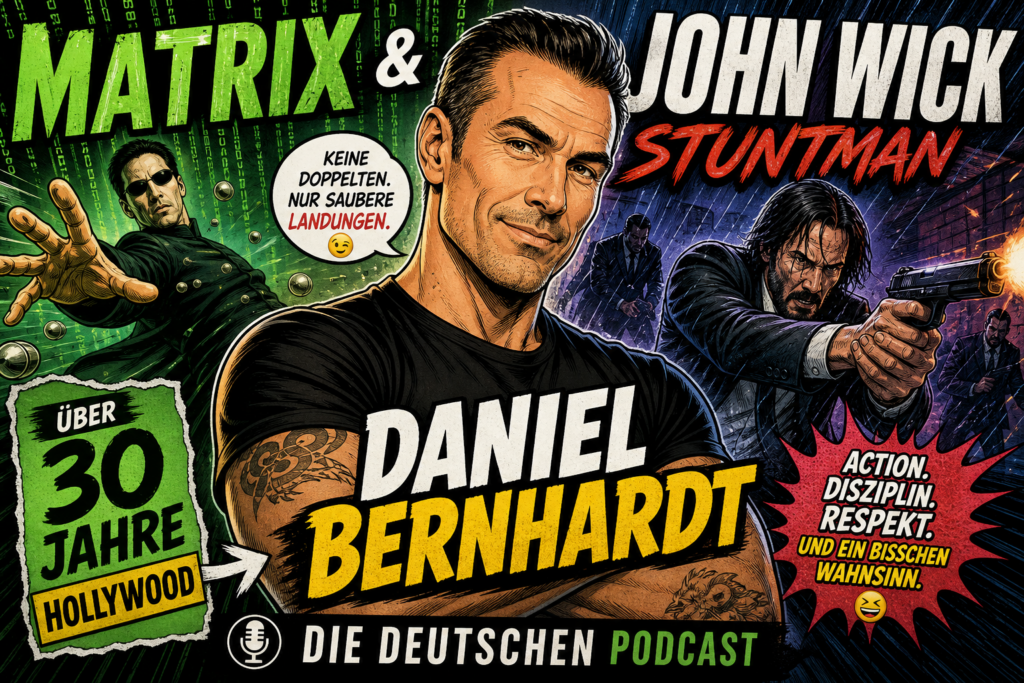
- Vom Kampfsport nach Hollywood: Daniel Bernhardts außergewöhnlicher Weg | Die Deutschen Podcast
- A World-Class Alpine Trail Is Being Killed Off – And the Reason Should Worry Every Rider

No responses yet